How to Use the Putting Line 3D Simulator
Set the green's slope, speed, and grain in this free simulator to see in real-time 3D how the ball breaks on its way to the cup — the putting line. It's a great way to practice and build intuition for "reading the line."
Use it in 3 steps
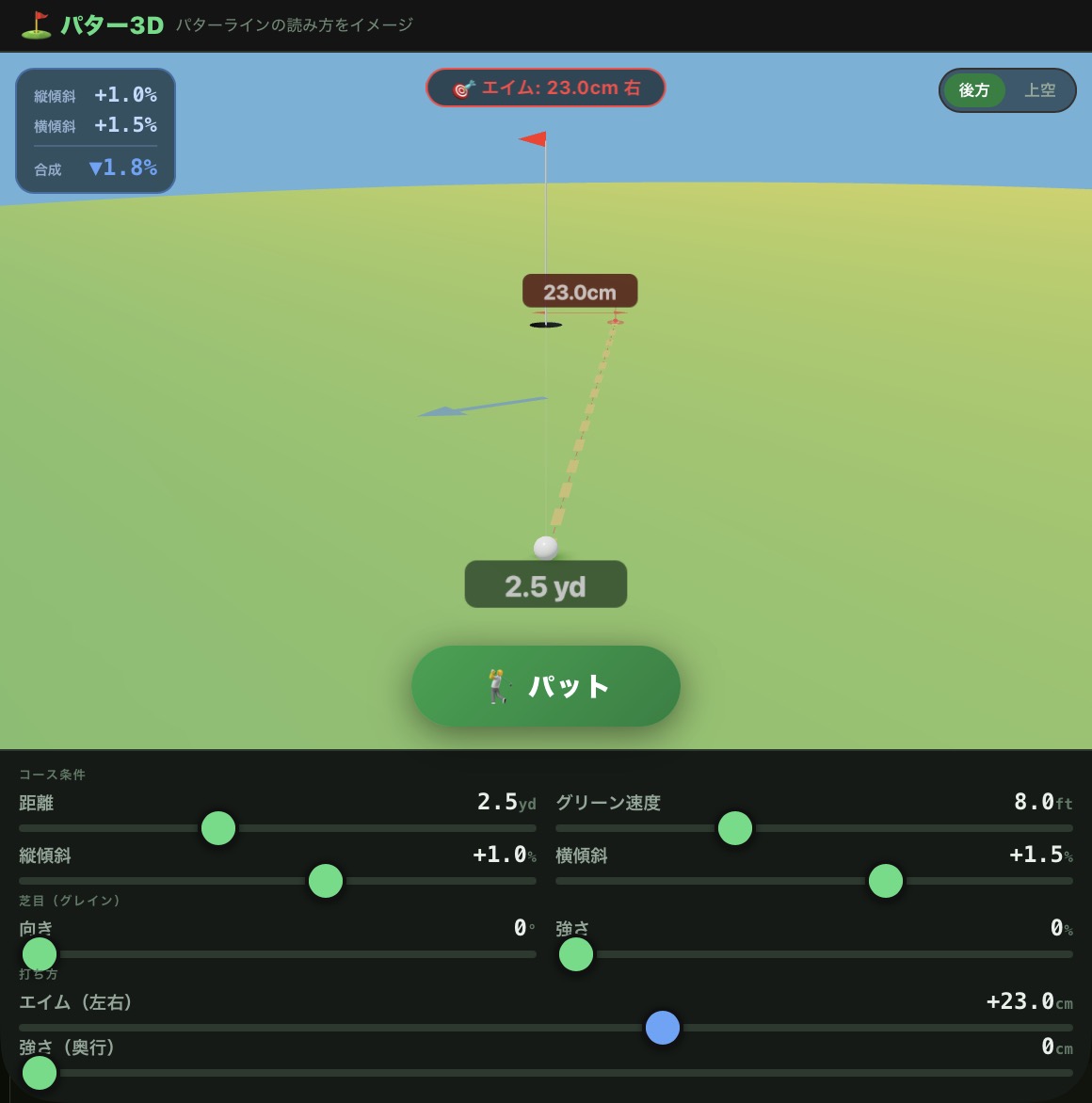
Use the Distance, Green speed, Pitch, and Side Slope sliders to recreate the putt in front of you. The panel in the top-left shows the slope values and the combined slope (▼).
Use Aim (L/R) to set your target line and Strength (depth) to control how far past the cup the ball would run. The red marker and arrow width show how far outside the cup's center you're aiming.
Press the Putt button and the ball rolls at its real speed, showing whether it's holed, lips out, or misses. Switch between the Behind and Overhead camera views to check the break from different angles.
What's shown on screen
- Yellow dashed line = launch direction (the direction the ball starts rolling)
- Red line and ring = aim point (target) and its left/right offset
- Blue arrow = the green's downhill direction (slope direction)
- White arrows = grain direction
- Ground color = elevation (darker = lower / lighter = higher)
Want to dial in your distance to the green too? Try GolfDistance Pro, which lets you test launch angle, spin rate, and elevation change in 3D.
The Basics of Reading a Putting Line
To sink a putt, you need to read the green's slope, speed, and grain, predict the curve (line) the ball will trace, and decide where to aim and how hard to hit it. Here's how each factor affects the line.
Slope and break
When there's side slope, the ball drifts toward the lower side as it rolls. This is a putt's "break." The greater the slope, and the slower the ball rolls, the more it breaks. Move this tool's Side Slope slider and you'll see the break direction and amount change instantly on the 3D green.
Hook lines and slice lines
A line that breaks from right to left is called a hook line, and one that breaks from left to right is called a slice line. Both are determined by the direction of the side slope. The rule of thumb is to aim at the "high side" (the pro side) relative to the direction of break.
The effect of green speed (stimp)
Green speed is measured with a stimpmeter — the higher the number, the faster the green. On faster greens the ball rolls slowly for longer, so the same slope produces more break. This tool lets you change speed across a 6–12 ft range so you can feel the difference for yourself.
How to choose an aim point
Allowing for the break, you aim not at the cup itself but at a spot "beside the cup, on the high side." How far outside you aim is the amount of break. This simulator marks the ideal aim point that sinks the putt with a red marker and an arrow showing the width, so you can grasp the feel both numerically and visually.
How hard to hit it
Hit it firmly and it breaks less; hit it gently and it breaks more. A common rule of thumb is that a putt with enough strength to run 30–45 cm past the cup tends to go in. Use the Strength (depth) slider to see how break changes with strength.
The effect of grain
Rolling with the direction the grass blades lean (the grain) makes the ball run further; rolling against it tends to stop the ball sooner. Sideways grain pushes the ball sideways. This tool lets you set the grain's direction and strength, and you can check its effect through the arrows and the ball's path.
Frequently Asked Questions
What does it mean to "read" a putting line?
It means reading the green's slope, speed, and grain, predicting how the ball will break, and deciding where to aim and how hard to hit it. Enter the slope and speed in this tool to see the break and the ideal aim point in 3D.
What's the difference between a hook line and a slice line?
A hook line breaks right to left, and a slice line breaks left to right. Both are set by the direction of the side slope — move the slider and the direction and amount are reflected in 3D.
How does green speed affect break?
Faster greens keep the ball rolling longer, so the same slope produces more break. Change the speed across 6–12 ft to feel the difference.
How do I choose an aim point?
Allow for the break and aim at a spot beside the cup, on the high side. This tool shows the ideal aim point with a red marker and an arrow showing the width.
How does grain affect a putt?
With the grain, the ball rolls further; against the grain, it stops sooner; sideways grain pushes the ball sideways. Set the direction and strength and check the effect via the arrows and path.